What Are Wood-Boring Insects?
Wood-boring insects are beetles and other insects whose larvae feed on timber. The larvae tunnel through wood before eventually emerging through small flight holes as adults.
The term "woodworm" is often used by homeowners, but it is actually a broad term covering several different insect species.
Each species has different timber preferences, environmental requirements and potential implications.
The most common insects encountered in UK residential properties include:
Common Furniture Beetle (Anobium punctatum)
Often referred to simply as woodworm, this is by far the most common insect encountered during residential surveys.
Typical signs include:
- Small round flight holes (approximately 1-2mm diameter)
- Fine gritty bore dust (frass)
- Localised damage to roof timbers, floor timbers and joinery
- Activity often associated with elevated timber moisture levels
Deathwatch Beetle (Xestobium rufovillosum)
Most commonly found in older properties containing hardwood timbers, particularly oak.
Characteristics include:
- Larger flight holes (approximately 3mm)
- Often associated with damp or decayed hardwood timbers
- More commonly encountered in churches, listed buildings and historic buildings
- Can cause significant damage if left unchecked
Wood-Boring Weevils
These insects are frequently associated with damp conditions and timber already affected by decay.
They are commonly found in:
- Sub-floor voids
- Cellars
- Wet or poorly ventilated areas
- Timber affected by prolonged dampness
In many cases, the presence of wood-boring weevils can indicate an underlying moisture problem that requires investigation.
House Longhorn Beetle (Hylotrupes bajulus)
Relatively uncommon in the UK but potentially serious.
Characteristics include:
- Large oval emergence holes
- Potential for significant damage to structural softwood timbers
- Traditionally concentrated within parts of South East England (fortunately, this means it's less likely to be an issue for us here in Devon)
Historic or Active? The Most Important Question
One of the biggest misconceptions surrounding woodworm is that visible flight holes automatically indicate an active infestation.
In reality, flight holes can remain visible for decades or even centuries after insects have gone.
Many homes contain historic evidence of wood-boring insects that no longer pose a risk.
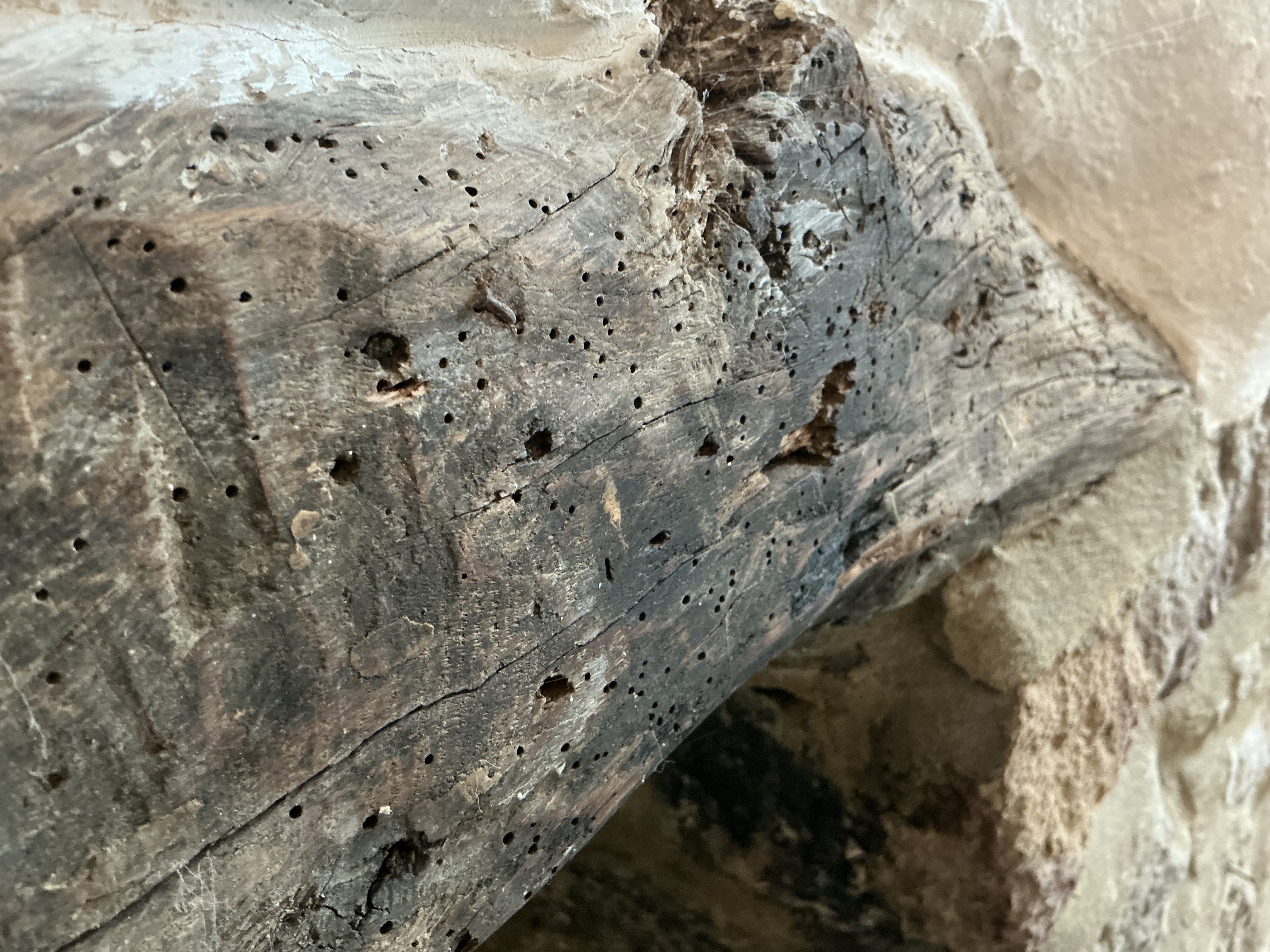
Historic Activity
Characteristics may include:
- Old darkened flight holes
- No fresh frass (bore dust)
- No evidence of recently emerged insects
- No obvious ongoing timber deterioration
It is particularly common to find historic insect damage in older and period properties, especially within:
- Exposed beams
- Fireplace lintels
- Floorboards
- Staircases
- Original roof timbers
In many cases these flight holes may be many decades or even centuries old.
It is important to remember that many older buildings have experienced periods of environmental imbalance during their lifetime. A property that has stood for 150, 200 or even 300 years may at some point have suffered from a leaking roof, blocked gutters, poor ventilation, condensation or prolonged vacancy. Such conditions can encourage insect activity. (PCA, 2024; BSI, 2021)
The presence of historic flight holes is therefore not unusual and is not normally a concern provided the timbers remain structurally sound and there is no evidence of ongoing infestation.
Active Infestation
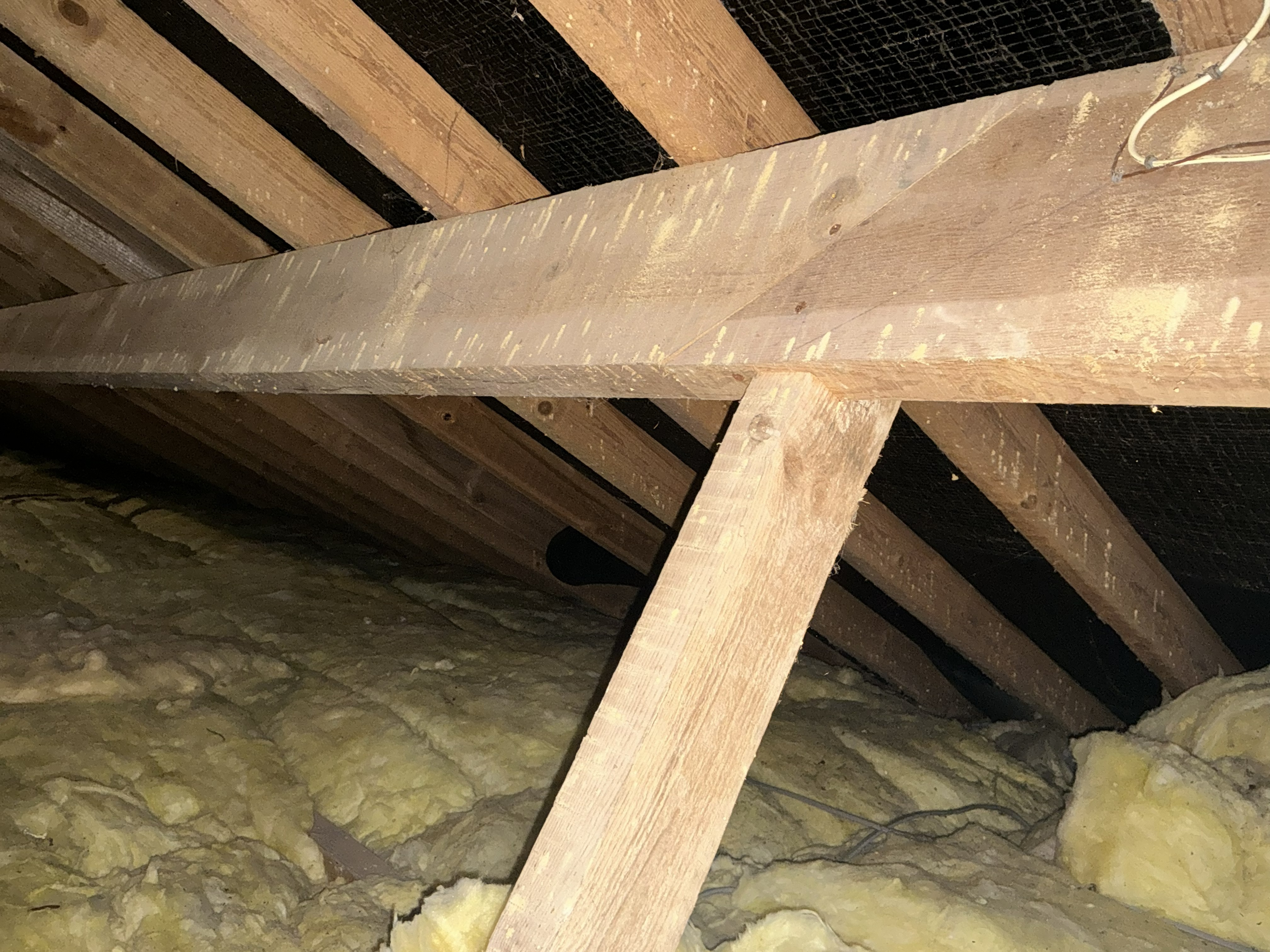
Indicators can include:
- Fresh pale-coloured frass
- Clean, sharp-edged flight holes
- Live insects
- Recently emerged beetles
- Ongoing timber deterioration
However, determining activity is not always straightforward and often requires specialist inspection, particularly where timbers are concealed.
Where Do We Most Commonly Find Insect Activity?
While insects can occur almost anywhere within a building, certain locations appear repeatedly during surveys.
Roof Spaces
The most common location we encounter is the roof void.
Particular attention is often required around:
- Loft hatches
- Loft access points
- Around damp or poorly ventilated rafters or purlins.
A common pattern occurs where warm, moisture-laden air escapes from the accommodation below into a colder roof void. This can create elevated humidity levels around nearby timbers, making conditions more attractive to some insect species. (PCA, 2024; Ridout, 2000).
For this reason, improving loft insulation continuity, reducing uncontrolled air leakage and improving roof-space ventilation can often be beneficial.
Suspended Timber Floors
The second most common location from our experience is beneath suspended timber floors.
Problems frequently arise where:
- Air bricks are blocked
- Ventilation pathways are obstructed
- Ground levels are too high externally
- Plumbing leaks occur
- Moisture becomes trapped beneath floors
Poorly ventilated floor voids can support not only insect activity but also timber decay, mould growth and poor indoor air quality.
Why Dampness Matters
Although many insect species can survive across a range of environments, numerous timber-destroying insects thrive much more readily where timber moisture levels and humidity are elevated.
For this reason, the focus of treatment should not simply be killing insects.
The primary objective is often making the environment less attractive to future infestation. This can include:
- Repairing roof leaks
- Fixing defective gutters and downpipes
- Repairing external defects
- Improving sub-floor ventilation
- Improving roof-space ventilation
- Reducing condensation
- Improving extraction to kitchens and bathrooms
- Maintaining sensible heating within the home
- Reducing moisture migration from living accommodation into roof spaces
Simply applying insecticide without addressing the environmental causes often provides only a temporary or partial solution. (PCA, 2023; BRE, 2007)
What Should a Pre-Purchase Survey Tell Me?
A RICS Level 2 or Level 3 Survey is intended to identify visible evidence of wood-boring insect activity and highlight potential risks. A surveyor may:
- Identify visible flight holes
- Comment on whether activity appears historic or potentially active
- Highlight factors which may increase risk
- Identify environmental defects contributing to infestation
- Recommend further investigation where appropriate
However, a pre-purchase survey is generally not intended to be a detailed timber investigation.
Surveyors are usually restricted to a visual inspection and cannot dismantle finishes, lift floors or undertake invasive investigations.
As a result, where activity appears widespread, active or potentially significant, further specialist investigations may be recommended.
What Does a Specialist Damp and Timber Survey Involve?
A dedicated damp and timber survey is generally much more detailed. Depending on the surveyor's qualifications and brief, investigations may include:
- Timber condition assessments
- Moisture profiling
- Timber moisture meter readings
- Roof void inspections
- Sub-floor inspections where access permits
- Identification of insect species
- Assessment of activity levels
- Evaluation of timber strength and extent of damage
- Recommendations for repairs and treatment
The objective is not simply to identify holes in timber but to establish:
- Whether activity is current
- Why it has occurred
- The extent of timber deterioration
- The most appropriate remedial strategy
Who Carries Out Timber Surveys?
Timber inspections can be undertaken by a range of professionals with different qualifications and experience.
PCA Qualified and Registered Surveyors
Property Care Association (PCA) members often undertake specialist damp and timber investigations. An appropriately qualified surveyor would hold as a minimum a Certificated Surveyor of Dampness in Building (CSDB) qualification (or similar older qualifications such as CSRT)
Many lenders specifically request PCA-qualified surveyors because PCA qualifications are widely regarded as some of the most specialist and rigorous routes available for professionals dealing with dampness, timber decay and wood-boring insects.
RICS Surveyors
Some Chartered Building Surveyors and Residential Surveyors have extensive experience identifying timber defects and understanding the wider building pathology that contributes to timber deterioration.
Specialist Timber Contractors
Many timber-treatment companies also provide surveys and quotations.
These can provide useful information but it is important to recognise that the survey and recommended treatment may form part of the same commercial process.
Independent Surveyor or Contractor?
This is a common question when purchasing a property.
Independent Surveyor
Advantages include:
- No direct financial interest in selling treatment
- Diagnosis-focused approach
- Recommendations may include multiple options
- Can help avoid unnecessary expenditure
Disadvantages include:
- Survey fees are payable
- Contractors may still be required afterwards
Timber Treatment Contractor
Advantages include:
- Often offers free inspections
- Can quickly provide quotations
- Convenient where treatment is clearly required your lender insists on treatment.
Disadvantages include:
- Recommendations may be influenced by available treatments
- Potential for over-specification of works
Free surveys can sometimes prove expensive in the long run if unnecessary treatment is recommended. However, this does not mean contractor surveys are poor value. Many contractors are highly knowledgeable and provide excellent advice.
The key difference is understanding whether the inspection is an independent diagnosis or part of a treatment proposal.
Is Insecticidal Treatment Always Needed?
The short answer is no.
Historically, it was common for timber treatment to be recommended whenever woodworm holes were discovered. Modern understanding of building pathology is more nuanced.
The first priority should always be determining:
- Whether infestation is active
- Which insect species is involved
- Whether structural damage has occurred
- Why the infestation developed
In many situations, correcting environmental conditions is more important than applying chemical treatment.
The Property Care Association's Code of Practice states:
"It should always be borne in mind that a statutory duty exists to avoid unnecessary use of wood preservatives/biocides."
This is an important principle.
The objective should be to correctly diagnose the problem and select the least intrusive effective solution, rather than automatically applying chemical treatments whenever historic flight holes are identified.
Treatment Options for Historic Activity
Where evidence appears historic and no active infestation is identified, options may include:
Do Nothing
This is often entirely appropriate where:
- Activity is historic
- Timbers remain structurally sound
- Conditions are dry and stable
- No further deterioration is evident
Monitoring
Periodic inspections may be sensible where uncertainty exists over activity levels.
Precautionary Treatment
Some owners choose precautionary insecticidal treatment for reassurance or during a property purchase.
If purchasing a property, it is sensible to ask whether previous timber treatment guarantees exist and whether they are transferable to subsequent owners.
Where no guarantee exists and historic insect holes are discovered, some owners choose to simply monitor the timbers while others elect for precautionary treatment. This is often a matter of preference rather than necessity.
Treatment Options for Active Infestations
Where infestation is confirmed as active, recommendations depend on the species involved, environmental conditions and extent of damage.
In most situations, an independent timber survey is the best starting point.
Environmental Improvements
Often the most important element of treatment. Works may include:
- Improving ventilation
- Repairing leaks
- Controlling condensation
- Drying damp timbers
- Improving drainage
- Correcting defects increasing humidity
Cleaning and Monitoring
After the environment is improved, for limited infestations:
- Existing frass may be removed
- Timbers can be monitored
- Further emergence can be assessed over time
Localised Timber Repairs
Where only isolated areas are affected, local repairs may be sufficient.
Insecticidal Treatment
Surface insecticidal treatment may be appropriate where active infestation is confirmed.
However, insecticidal treatment should not be considered a substitute for addressing the environmental conditions that encouraged infestation in the first place.
In most successful long-term solutions, building repairs, moisture management and environmental improvements are undertaken alongside any chemical treatment.
How Much Does Timber Treatment Cost?
Costs vary significantly depending on access, extent of infestation, species involved and timber repair requirements.
As a broad indication for a typical three-bedroom semi-detached property with a light to moderate infestation:
- Independent timber survey - £250 - £600
- Localised insecticidal treatment - £500 - £1,200
- Roof void treatment - £1,000-£2,500
- Extensive suspended floor treatment - £1,500-£4,000+
- Timber repairs or replacement - Highly variable
These figures are intended only as broad guidance and costs vary between contractors, regions and property types.
It's Not Always About the Insects
One of the most important points often overlooked is that even if insect activity has ceased, timber-related problems may still remain. For example:
- Poor sub-floor ventilation may still create conditions for fungal decay.
- Condensation in roof spaces may continue to affect timber performance.
- Damp floor voids may contribute to poor indoor air quality.
- Elevated moisture levels may support mould growth.
The discovery of woodworm holes often leads homeowners to focus on insect treatment, but in many properties the more important issue is understanding why the infestation occurred in the first place.
Proper ventilation, moisture control and ongoing building maintenance are often the most effective long-term protection against future timber problems.
When Should You Arrange Further Investigation?
Further timber investigations may be worthwhile where:
- Active infestation is suspected
- Flight holes are widespread
- Timbers feel soft or weakened
- Significant roof timbers are affected
- Floor structures show deterioration
- Mortgage lenders require specialist reports
- Signs of dampness or timber decay are also present
Need Advice About Woodworm, Dampness or Timber Decay?
At Nova Surveyors, we provide independent damp and timber investigations to help homeowners, buyers and property professionals understand not just what defects are present, but why they have occurred and what the most appropriate solution may be.
Whether the issue involves historic woodworm, suspected active infestation, timber decay, sub-floor ventilation problems or condensation within roof spaces, our surveys focus on diagnosis first and treatment recommendations second.
Find out more about our Damp and Timber Surveys here: Damp and Mould Services | Nova Surveyors
References
BRE (2007) Understanding Dampness. Watford: Building Research Establishment.
Property Care Association (2023) Code of Practice for Remedial Treatment of Timber. Huntingdon: Property Care Association.
Property Care Association (2024) Guidance on Timber Infestation and Remedial Treatments. Huntingdon: Property Care Association.
Royal Institution of Chartered Surveyors (2021) RICS Home Survey Standard. London: RICS.
BSI (2021) BS 7913: Guide to the Conservation of Historic Buildings. London: British Standards Institution.